On a cold Himalayan morning, there are few comforts as familiar as a cup of tea.
The kettle comes to a boil. The leaves unfurl. Steam curls into the crisp mountain air before dissolving into the mist that hangs over the valleys. Somewhere beyond the clouds, the first rays of sunlight brush the tea gardens, and another day quietly begins.
For most of us, it is simply tea.
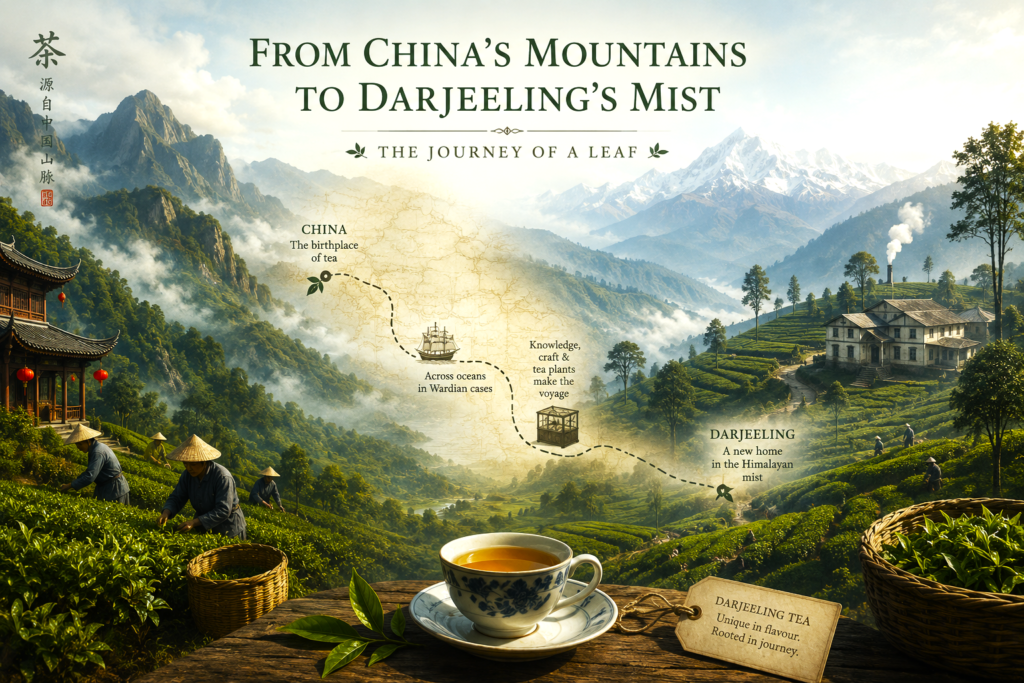
Yet every cup carries the story of Darjeeling tea – a journey that began long before the first bush was planted on these hills.
Long before Darjeeling became synonymous with fine tea, the story belonged to another landscape entirely.
It began among the mist-covered mountains of China.
There, for centuries, tea was more than an agricultural crop. It was a craft refined across generations. Families understood the subtle rhythm of the seasons—when the youngest leaves should be plucked, how long they should wither, how firmly they should be rolled, when oxidation had reached its perfect moment, and how heat could preserve both flavour and fragrance. These were not secrets written in books. They were learned through years of observation, patience and practice.
By the nineteenth century, the world had developed an insatiable appetite for tea. Britain’s ports received ship after ship carrying Chinese tea across the oceans. It had become a drink that crossed every social class—from elegant drawing rooms to factory workshops.
There was only one problem.
Britain depended almost entirely on China for its supply.
The British East India Company began searching for a way to grow tea within India itself. Not merely to possess the plant, but to master the craft that transformed an ordinary green leaf into one of the world’s most valuable commodities.
In 1848, that search led to an unusual expedition.
A Scottish botanist named Robert Fortune travelled into China’s tea-growing regions, places that were then largely closed to foreigners. Dressed in Chinese clothing and adopting local customs, he moved quietly through villages and mountain plantations, observing every detail he could.
The real prize, however, was never just the tea plants.
Fortune returned with something far more valuable: an entire body of agricultural and manufacturing knowledge. He studied how tea was cultivated, plucked, withered, rolled, oxidised and dried. He persuaded experienced Chinese tea makers to travel to India, and carefully packed thousands of young tea plants into remarkable glass Wardian cases—miniature greenhouses that protected them during the long sea voyage.
That transfer of knowledge would help reshape the economy of the eastern Himalayas.
By then, another discovery had already changed Britain’s plans.
In the forests of Assam, wild tea plants had been found growing naturally, proving that India possessed its own native tea. Yet the British were also searching for cooler mountain landscapes that resembled the tea-growing regions of China.
Their eyes turned towards Darjeeling.
The resemblance was striking.
The altitude. The drifting mist. The cool summers. The generous rainfall. The steep mountain slopes where clouds lingered long after sunrise.
It was a landscape that seemed to welcome the Chinese tea plant.
Experimental gardens soon appeared. The bushes took root. Chinese methods met Himalayan conditions, and something entirely new began to emerge.
But plants alone do not create an industry.
Roads had to be cut into mountainsides. Nurseries established. Factories built. Tea had to be carried down winding hill roads long before there were highways connecting the hills to the plains.
Most importantly, generations of workers transformed those early experiments into living landscapes. Season after season, they planted, pruned and carefully plucked only the youngest leaves. Inside the factories, each basket passed through skilled hands that understood the delicate balance between moisture, air, heat and time. The character of Darjeeling tea was not born in a single moment of discovery. It was shaped over decades by climate, craftsmanship and countless pairs of hands.
As the years passed, tea from these Himalayan gardens acquired a reputation unlike any other. Connoisseurs spoke of its delicate aroma, bright liquor and the floral notes that could not easily be reproduced elsewhere. Before long, the name “Darjeeling” itself had become synonymous with some of the world’s finest tea.
Its story, however, belongs to no single nation or individual.
Chinese growers preserved centuries of knowledge. A Scottish botanist carried that knowledge across oceans. Assam revealed that India had tea of its own. The hills of Darjeeling offered a climate unlike any other. And generations of workers turned possibility into reality.
History is rarely the work of one remarkable person. More often, it is the meeting of landscapes, ideas and people whose paths unexpectedly cross.
The next time you wrap your hands around a warm cup of Darjeeling tea, pause for just a moment.
Inside that quiet ritual is a journey stretching across mountains, oceans and empires—a journey that began in the mist-covered hills of China before finding a second home among the clouds of the eastern Himalayas.
Every cup is, in its own quiet way, a map of that remarkable voyage.
From China’s Mountains to Darjeeling’s Mist
By Adwitiya Chhetri
Kalimpong Journal