People used to call it the Universal Dasain.
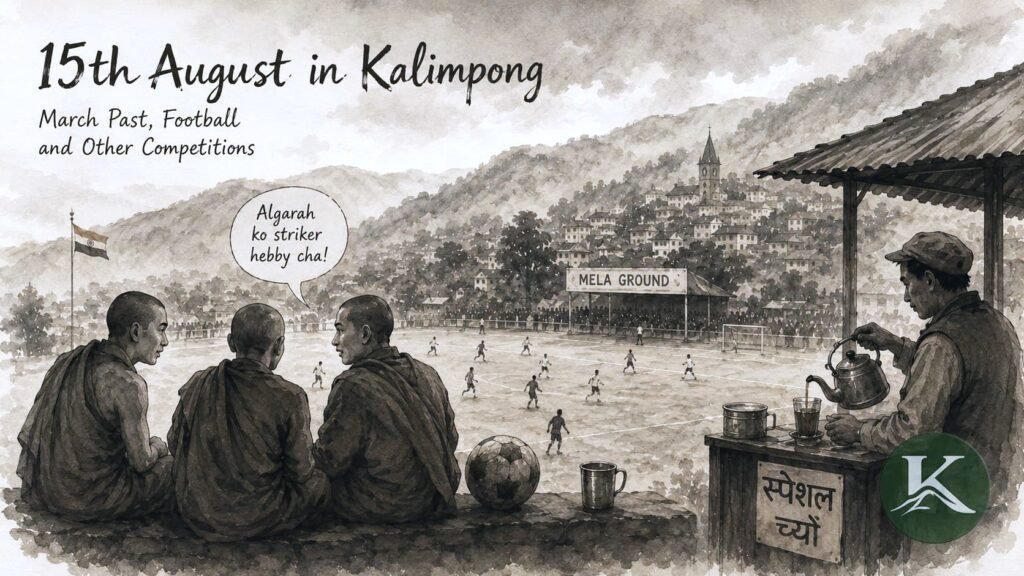
The football season arrived long before Independence Day. By July, football had become difficult to avoid. Taxi drivers discussed team selections, dangerous strikers and defenders while waiting for passengers. Shopkeepers offered predictions between customers. Schoolboys possessed confidential information from highly unreliable sources.
The League Cup usually kicked things off. Shahid Cup came next, followed by Ravi Lal. Independence Cup arrived after them. By August, many people had usually lost track of which tournament they were discussing.
Nobody seemed particularly troubled by this.
Evidence was appreciated.
Its absence seldom interrupted discussion.
I found myself at Mela Ground one afternoon towards the latter half of July.
Clouds had spent most of the day gathering around Deolo Hill. They had not yet committed themselves. This was not unusual.
Around the touchline, spectators had already settled into familiar positions. Tea hawkers moved steadily through the crowd carrying steel kettles. Badam sellers followed close behind.
Every few minutes, somebody arrived, greeted three people, ignored the match for ten minutes and quietly joined whatever conversation happened to be in progress.
Near one corner of the ground, where I was sitting, a group of monks were loudly debating a striker from the Algarah team.
With every mention, the striker acquired new skills and hidden talent.
One monk claimed he could score from anywhere inside the opposition half.
Another claimed he could score whenever he wanted.
People around them listened respectfully.
It appeared that nobody had actually seen him play.
For most of the year, Mela Ground was simply a field. Children crossed it on their way home from school. Dogs slept on it. Eager kids learned to ride their bicycles. Grass grew where it pleased. On quieter afternoons, there was little to suggest that thousands of people would eventually gather here.
Then football season arrived.
Cardboard sheets appeared.
Wooden stools and piras appeared.
Crowds gathered.
Arguments followed.
So did the rain.
For a few weeks each year, the field acquired greater ambitions.
Mela Ground, like most things in Kalimpong, operated within certain practical limitations.
One of these involved footballs.
There were two during most matches, and for most afternoons, this was enough.
After a corner by the boys in blue, a clearance travelled well beyond the intended destination and disappeared downhill towards Bagdhara.
A few minutes later, a second clearance followed a remarkably similar route.
This created a temporary administrative challenge.
Several volunteers were dispatched downhill.
The crowd accepted the situation calmly.
Similar incidents had occurred before.
The interruption allowed spectators to revisit earlier disagreements regarding team selection, refereeing standards and the prospects of the Algarah striker, some veering into entirely unrelated conversational tangents.
A little further down the terraces, three young women had spent the better part of the first half discussing somebody who was not on the field.
His name came up frequently.
So did another young woman’s.
The conversation moved steadily through rumour, speculation, advice and his future.
The football appeared to be progressing independently.
Tea and peanut sales increased noticeably during the hiatus.
The footballs eventually returned.
Not everybody noticed immediately.
———————————–
The closer Independence Day approached, the more the town seemed to lean towards it.
You could see it in small ways.
Porters carried sacks of rice, crates of soft drinks and Sikkim Beer, and alarming quantities of meat and vegetables into restaurants preparing for the crowds. Hotels filled with visiting teams. Everywhere else, somebody seemed to be expecting somebody.
The rest of the town appeared to be conducting tournaments of its own.
Meanwhile, the weather continued behaving like August. A stretch of sunshine persuaded somebody to hang laundry outdoors. Twenty minutes later, the rain expressed a different opinion.
By now, the marching contingents were receiving their final instructions. The rehearsals had begun weeks earlier. Some schools had started considerably earlier than others.
For several weeks, physical education teachers attempted to convince students that synchronized walking was an important civic skill.
At ours, the process involved repetition, discipline and occasional shouting.
Opinions differed.
The school band could be heard long before it could be seen. On certain afternoons, drumbeats drifted across town. Somewhere in the distance, another band answered.
For a few weeks every year, Kalimpong acquired its own soundtrack.
Around the same time, certain boys began paying unusual attention to personal appearance.
Haircuts appeared.
Shirts improved.
Small groups developed an interest in stationery shops.
Many theories existed.
One afternoon, I found myself sharing a taxi towards Tirpai.
The Assam Rifles goalkeeper was under discussion.
By this point, he had acquired unusual abilities.
One passenger claimed the man was a magnet.
Another nodded without hesitation.
A third insisted he had personally witnessed three shots struck directly at him during one match.
Nobody in the taxi appeared troubled by the absence of independent witnesses.
By the time we reached Tirpai, he had acquired several more abilities.
Meanwhile, football teams continued arriving from neighbouring districts, the plains, Nepal and Bhutan. Visiting players wandered through town in small groups, occasionally attracting local football experts.
Advice was offered freely.
Requests were not always necessary.
Above all this, the clouds continued gathering over Deolo.
They appeared to be discussing whether the evening deserved rain.
They had not yet reached a decision.
————————————
The morning belonged to the schools.
By the morning of the 15th, Kalimpong had surrendered itself to marching contingents. School bands echoed from different parts of town long before they came into view. Roads that normally belonged to taxis and pedestrians now belonged to polished shoes, drumbeats and carefully measured footsteps.
For a few hours, perfect straight lines seemed entirely attainable.
Experience suggested otherwise.
The march-past was presided over by Mr. CK Pradhan, instantly recognisable by his long beard and dark glasses. The sunglasses remained in place regardless of weather conditions. This included fog.
The formal greetings were delivered. A few announcements followed. Then came the one everybody had actually been waiting for.
The 17th would also be a holiday.
The applause suggested this was the most successful speech of the morning.
The first contingent stepped forward. Drums rolled. Commands echoed across the ground as one school after another marched past the dais before disappearing back into town.
Outside the ground, friends searched for familiar faces. Parents searched for their children. Students searched discreetly for entirely different people.
Some succeeded. Others spent the remainder of the day pretending they had not been searching at all.
By late morning, school uniforms had begun disappearing into school bags. The streets filled with children and teenagers, although they no longer looked quite the same as before.
The faces were familiar. The hairstyles were not.
Around Motor Stand, older men had already occupied the better tables. Glasses clinked. Plates arrived. The outcome of the afternoon’s final had begun receiving expert analysis from individuals who had not yet seen either team play.
Nearby, hawkers were doing brisk business. Aloo thukpa continued arriving on fig leaves. Supply struggled to remain ahead of appetite.
Further up, Damber Chowk had found its annual soundtrack. One cassette jockey sat beneath an impressive arrangement of speakers, accepting folded slips of paper with the quiet efficiency of somebody who had been entrusted with more than music.
Boys and girls approached one at a time.
They spoke into his ear. He nodded.
A few minutes later, another love song drifted across the square.
Some romances probably began that afternoon. Some others had probably started two or three days earlier.
Others, having survived almost five days since the 10th of August, were already showing signs of strain.
Near Thana Dara, a group of girls who had taken part in the Tibetan Singay dance rested in the shade, cheeks still flushed from the morning’s performance. Outside a tea shop, conversation paused briefly. The previous night’s rain in Mirik had swept away part of a hillside. Somebody wondered aloud whether the weather might attempt something similar before evening.
The clouds gathering above Deolo declined to comment.
By now, the afternoon had begun rearranging itself. Conversations ended with surprising efficiency.
“Jum haina abo?”
Nobody asked where. Nobody needed to.
The roads had already decided.
From every direction, people drifted towards Mela Ground.
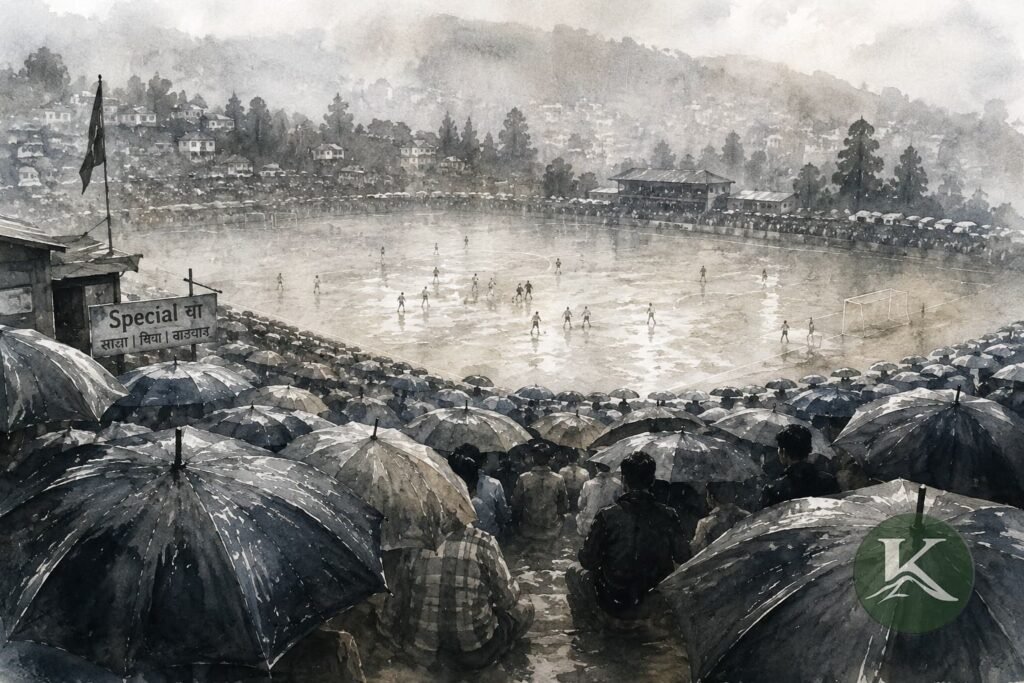
By the time I reached the terraces, the better places had already disappeared. Late arrivals borrowed cardboard from nearby shops with the confidence of people who had borrowed it before and fully intended to return it afterwards. Others accepted damp grass as part of the admission fee.
The senior final had not yet begun, though that did little to discourage discussion. One side warmed up near the far touchline. The other had already been judged superior.
Tea hawkers resumed familiar routes through the terraces carrying steel kettles that appeared considerably heavier uphill than downhill. Badam sellers threaded themselves through impossible gaps. A cucumber seller wandered past carrying neatly arranged slices dusted with salt and chilli.
On this day, Mela Ground had quietly solved one of its longstanding administrative problems.
There were five footballs.
Experience had suggested this was preferable.
The referee checked his watch. The whistle followed.
The terraces quickly settled into their own rhythm.
Every pass received advice. Every tackle received an opinion.
Midway through the first half, a defender mistimed an interception and landed heavily on the wet ground. Somewhere behind me came an immediate medical assessment.
“Oye, glucose khayera aija!”
The player got up.
The diagnosis appeared successful.
The first few drops attracted little attention. Around Kalimpong, rain in the middle of August possessed very little novelty.
A cross arrived from the left. The striker met it first.
For perhaps three seconds, everybody agreed. Then somebody noticed a hand.
Within moments, several hundred people had independently reached the same conclusion.
The referee pointed towards the centre circle.
The goal stood.
His popularity did not.
“Referee le ghoos khaye cha!”
Very few dissenting opinions were recorded.
The referee declined to respond.
This decision also attracted criticism.
The rain became considerably more committed. Umbrellas appeared one after another until large sections of the match became temporarily theoretical.
People in front stood.
People behind objected.
Neither side altered its position.
From somewhere beneath a blue polyester umbrella came another voice.
“Oye, 4 number! Polio ko dabai khayera aija!”
Number 4 continued without medication.
Visibility deteriorated steadily. The football appeared only in brief intervals between umbrellas and shoulders. For everyone else, the commentary came from the crowd.
It proved remarkably comprehensive.
Badam sales remained steady.
The cucumber seller, perhaps recognising changing market conditions, quietly disappeared.
The rain eventually abandoned all restraint. A few spectators gathered their cardboard and accepted defeat.
Most did not.
The match continued.
So did Kalimpong.
——————————–
The rain settled over Mela Ground with the confidence of something that had attended many finals before. Football continued in brief intervals between umbrellas.
One attack.
A blue shirt.
Half a goalkeeper.
Then polyester.
A roar travelled across the terraces.
Several different explanations followed.
Not all of them described the same incident.
Somewhere below, the referee blew his whistle again.
The crowd responded immediately.
He remained unconvinced.
The match eventually found a winner.
I no longer remember who.
That seemed important at the time.
It seems considerably less important now.
What I remember is the town.
The tea hawker who completed one final round before giving up on the rain.
The badam seller who appeared to know every gap in the terraces by instinct.
The cucumber seller who quietly decided the weather had become unreasonable.
The boys discussing football while secretly watching somebody else.
The girls pretending not to notice.
The cassette jockey, probably still announcing another dedication somewhere below Damber Chowk.
The old men who had confidently predicted an entirely different result.
The umbrellas.
The arguments.
The weather.
————-
Football brought us to Mela Ground.
Everything else kept us there.
Perhaps that was why people called it the Universal Dasain.
Not because everybody watched football. Many didn’t. Some spent the afternoon discussing referees, romances, landslides in Mirik and politics. Some never looked at the pitch at all.
Yet somehow, every one of them had turned up.
Every August, just before the monsoon began losing interest in the hills, football, rain and Kalimpong entered into an old agreement. For one afternoon, the town gathered in one place and behaved exactly like itself.
The trophy was eventually carried home by one team.
The afternoon belonged to everybody.
— By Adwitiya Chhetri
From Notes From Kalimpong, first published in Kalimpong Journal.
© 2026 Adwitiya Chhetri. This work forms part of the forthcoming collection Notes From Kalimpong. All rights reserved. No adaptation, republication, narration, recording, translation or derivative work may be made without the author’s prior written permission.
Brilliantly captured nostalgia! Enjoyed the read.
I could visualise every word written here, every word came alive as I read it.
Ditto! 🙂