How the reopening of Nathu La reminds us of the roads that shaped the Eastern Himalayas
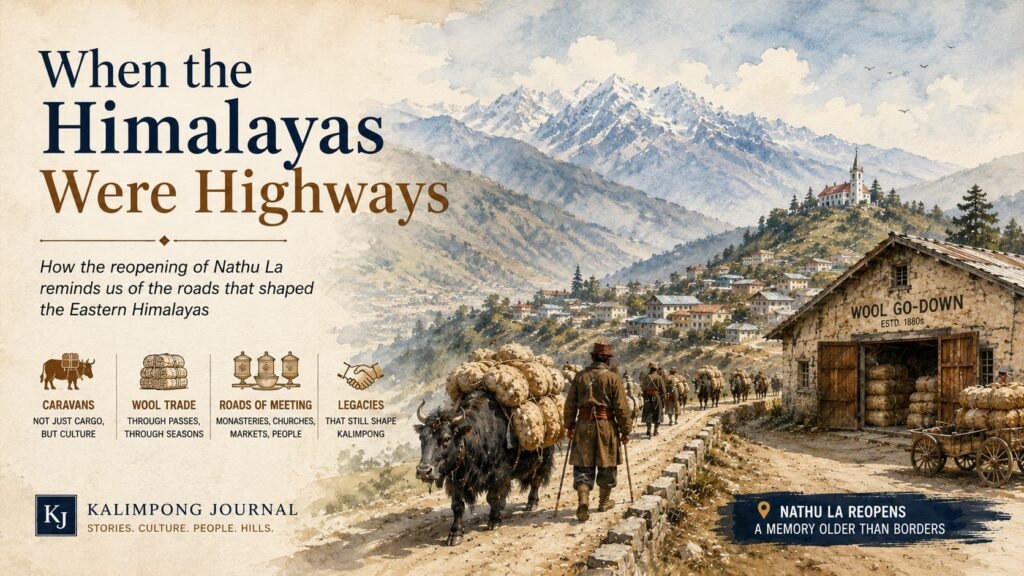
When Nathu La reopened this week after six years, many saw it as another diplomatic development between India and China. But for the Eastern Himalayas, the moment carries a much older memory.
Long before passports, customs posts and international borders, these mountain passes connected communities across the Himalayas. Traders, pilgrims and caravans crossed them every season, carrying wool, salt, tea, brass utensils, medicinal herbs, stories, beliefs and friendships. The reopening of Nathu La may be limited in scope, but it quietly recalls a time when these mountains were corridors of exchange rather than barriers. For the Eastern Himalayas, it is an invitation to remember the journeys that helped shape its towns, its communities and its people.
The Himalayas are often imagined as walls.
For generations, they were roads.
Before sunrise, the first sound was never a voice.
It was the gentle ringing of yak bells somewhere beyond the morning mist.
Frost still clung stubbornly to the grass as wooden pack saddles were tightened one last time and ropes checked against another day’s climb. Someone crouched beside a small fire, coaxing tea to a boil while another worked tsampa between weathered hands before the day’s climb began. Prayer beads slipped quietly through patient fingers. A mule stamped impatiently against the frozen ground. Nearby, a horse shook the night’s frost from its mane.
By the time the first light reached the ridges, the caravan had already begun winding its way towards the pass.
The loads were familiar.
Bales of wool.
Blocks of salt.
Tea.
Bundles wrapped carefully against rain and mountain mist.
Everything had its place, balanced so that neither man nor animal would bear more than the mountain allowed.
The climb demanded patience.
A misplaced step could send loose stones tumbling into the valley below. Snow still lingered in shaded gullies long after spring had reached the lower hills. A clear morning could dissolve into drifting flakes, swallowing the trail before the caravan had gone another mile. Some days the journey covered little more than a few miles before stopping again.
By the time the trail emerged from the mist, the worst of the weather had passed. The caravan pressed on. Beyond the next ridge lay another valley, another halt and, eventually, another market. There were people waiting beyond the mountains.
Every caravan carried more than its cargo.
A trader leading laden yaks might spend part of the day beside a monk travelling towards a monastery in another valley. Pilgrims joined the same paths. Messengers carried letters between kingdoms. A shepherd heading home might walk with the caravan for a few hours before turning towards a village hidden among the hills.
At day’s end, strangers often shared the same fire.
Someone spoke of heavy snowfall beyond the next ridge.
Someone else warned that a bridge had been damaged by rain.
Tea was poured. The kettle was passed around.
Days later, the landscape began to change.
The windswept plateau slowly gave way to forests. Rhododendrons clung to steep hillsides. Streams born of melting snow gathered strength with every bend, hurrying towards the valleys below as the caravan descended into the hills. Villages appeared more frequently now, their timber houses sending thin ribbons of smoke into the afternoon air. Children paused in their games to watch the long line of pack animals before disappearing again behind wooden fences.
At Rhenock, one of the caravans turned aside. Its loads would be unpacked there, destined for nearby settlements that had been waiting since the beginning of the trading season.
The rest pressed on. Beyond the next ridge, another town was beginning its day.
By late afternoon, the caravan reached Kalimpong Bazaar.
Before the first loads were untied, the smell of raw wool hung heavily in the cool mountain air. Porters called to one another as they guided the pack animals towards the warehouses. Somewhere, a blacksmith’s hammer rang steadily against hot iron. A few shopkeepers appeared in their doorways, watching the latest arrivals with quiet curiosity rather than surprise.
The innkeeper recognised familiar faces before they had even unpacked their loads.
Rooms were prepared.
The animals were led away to be watered and fed.
Someone had already set another kettle over the fire..
Bales of wool leaned against timber storefronts awaiting buyers. Salt changed hands beside brass utensils that had travelled up from the plains. A merchant concluded a bargain in Tibetan before greeting his next customer in Nepali. Across the lane, a Marwari trader carefully adjusted the balance on his weighing scale while a porter waited patiently for the nod that meant another load could be carried inside.
Children hovered near the pack animals, daring one another to touch the brass bells hanging from a yak’s neck before a sharp voice sent them scattering again. Somewhere nearby, warehouse workers disappeared into the dim interiors of the go-downs, their voices echoing through the timber beams as another season’s wool found its place.
Conversation drifted as easily as trade.
“You are late this season,” a shopkeeper called out while helping untie a stubborn knot.
“The snow had other plans,” the trader replied, brushing dust from his coat.
Laughter followed.
A porter carrying a heavy load paused just long enough to listen before disappearing into one of the warehouses. By evening, the story had travelled further through the bazaar than the caravan itself.
Before long, someone was asking after a trader who had not been seen since the previous season. Another wanted news from beyond the passes. A porter carrying two heavy bundles excused himself through the gathering crowd while a child hurried after the last yak, determined to touch the brass bell before it disappeared behind the warehouses.
It was simply another evening in a Kalimpong Wool Go-Down.
By now the day’s bargaining had begun to slow.
A cook stirred a steaming pot while tired porters stretched aching shoulders after unloading the final bales of wool. Someone repaired a frayed harness by the fading light. Nearby, warehouse workers rolled the last heavy bundles deeper inside the go-downs before fastening the great wooden doors for the night.
Outside, the caravan rested.
Before sunrise the following morning, the ropes would be tightened once more. Some of the wool would begin its journey towards the plains. Tea, cloth, brass utensils and other goods would make their way back into the mountains. A few familiar faces would remain behind for another day or two before beginning the long climb once again.
The market would return to its ordinary rhythm.
The caravan disappeared over the next ridge.
Weeks later, another would arrive. Then another. Season after season, the Wool Go-downs filled and emptied with the rhythm of the mountain roads. Fresh bales were sorted, weighed and prepared for their onward journey to the plains while new caravans waited patiently outside the warehouses.
Years passed. Then decades.
The caravans became fewer. The great seasonal journeys that had once brought the mountains to life slowly faded. The Wool Go-downs found new purposes. Roads carried buses and trucks instead of long lines of pack animals.
Yet the mountains did not forget so easily.
Their memory lingered in unexpected places. In a few borrowed words that found a home in everyday speech. In recipes that had travelled from one valley to another. In old buildings that had outlived the trade they were built to serve. In towns that grew because people kept arriving, each journey leaving behind something that outlasted the traveller.
That may be why places like Kalimpong still feel different.
They were shaped not by one community alone, but by generations of meeting—by countless ordinary encounters repeated until they became part of the landscape itself.
History often remembers treaties, wars and borders.
The mountains remember footsteps.
Epilogue
The great trading caravans that once defined these mountains have long since passed into history.
On 1 August 2026, India and China resumed border trade through Nathu La after a six-year suspension that began during the COVID-19 pandemic and was prolonged by tensions following the 2020 Galwan Valley clashes. The trade that has resumed today is far smaller in scale than the historic exchanges that once sustained Himalayan communities, but the reopening nevertheless marks an important moment for the Eastern Himalayas. It quietly reawakens memories of a much older Himalayan tradition in which mountain passes connected communities rather than merely separating nations.
Selected References
- Bell, Charles. Tibet: Past and Present. Oxford: Clarendon Press, 1924.
- Bell, Charles. The People of Tibet. Oxford: Clarendon Press, 1928.
- Das, Sarat Chandra. Journey to Lhasa and Central Tibet. London: John Murray, 1902.
- Risley, H. H. The Gazetteer of Sikhim. Calcutta: Bengal Secretariat Press, 1894.
- Waddell, L. Austine. Among the Himalayas. Westminster: Archibald Constable & Co., 1899.
- Government of India. Report of the India–China Border Trade through Nathu La (historical and contemporary government records).
- Government of India, Ministry of Commerce & Industry. Official notifications regarding the resumption of border trade through Nathu La (2026).
- Government of Sikkim. Historical records on the Nathu La and Jelep La trade routes.
- Government of West Bengal. Archival material relating to Kalimpong’s trans-Himalayan trade and Wool Go-downs.
Acknowledgement
This article is a historical reconstruction based on published histories of the Himalayan trade routes, archival sources and contemporary accounts. Individual scenes and conversations are imagined, but are intended to reflect the lived realities of the trans-Himalayan caravan trade.
© 2026 Adwitiya Chhetri. All Rights Reserved.
This is an original literary work first published on Kalimpong Journal. While based on historical research, the narrative structure, scenes and dialogue are original to the author. No part of this work may be reproduced, adapted, translated, narrated, recorded, or used in any film, television, web series, audiobook, podcast, video, or other audiovisual production without prior written permission.