A Short History of Human Devolution
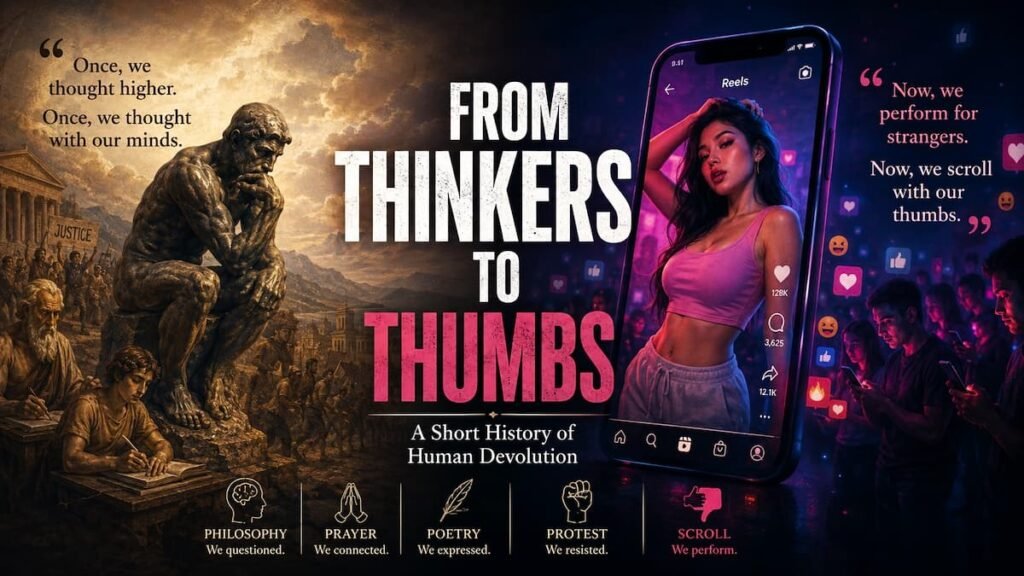
We have more information than any civilisation in history. We carry libraries in our pockets, lectures in our headphones, and the collective knowledge of humanity a few taps away. Yet much of our waking life is spent watching strangers perform for strangers. Somewhere between intelligence and attention, something went wrong.
Once, human beings were admired for their ability to reason, imagine and create. We built temples before shopping malls, wrote epics before captions, and argued over philosophy instead of comment sections. We certainly weren’t perfect, but there was at least an assumption that the mind deserved exercise. Today, our greatest technological achievement appears to be discovering increasingly creative ways of asking strangers to look at us.
If Charles Darwin returned in 2026, he probably wouldn’t spend much time studying finches. He’d study Instagram. Not because social media is evil, but because nowhere else can you find millions of unrelated people performing the same dance, to the same song, making the same expression, within days of each other—as though summoned by a drumbeat audible only to the algorithm.
Animals have always performed courtship rituals. Peacocks spread feathers. Birds sing. Fireflies glow. Humans invented ring lights.
Of course, attraction itself isn’t the problem. Every civilisation has celebrated beauty, romance and desire. The difference is that these things once carried context. They belonged to relationships, stories, responsibilities and mystery. The internet discovered they also generate engagement—and engagement pays. So intimacy became content. Attention became currency. The private became public. What once required vulnerability now requires good lighting.
Perhaps the most remarkable achievement of social media is not that it changed what people do, but that it convinced us this was always what we wanted to do. Psychologists describe the human mind as a balance between impulse, reason and conscience. The algorithm solved that balance by handing the microphone entirely to impulse. Every opinion must be shared. Every meal documented. Every holiday filmed. Every emotion announced. Silence, once considered thoughtful, now looks suspiciously like poor engagement.
The tragedy isn’t that people seek attention. Humans have always wanted to be noticed. The tragedy is how cheaply we now sell it. The loudest voices are rarely the wisest. Outrage travels faster than reflection. Performance spreads more easily than substance. The algorithm has no opinion about truth, beauty or wisdom. It asks only one question:
Did they keep watching?
That is a dangerous standard for any civilisation.
History remembers philosophers, teachers, scientists and artists because they expanded the human mind. Our own era may be remembered for reaction videos, apology videos and fifteen-second clips that disappear from memory before the next one begins. Even our distractions have become disposable.
There was a time when boredom produced books, inventions and conversations. Now boredom lasts about eight seconds before the thumb begins scrolling again. Perhaps that is the real story—not moral decline, but attentional decline. We haven’t merely become more distracted. We’ve become less capable of being alone with our own thoughts. And without reflection, judgement slowly gives way to instinct.
Even lust used to require imagination. Now it requires Wi-Fi.
The line is amusing, but it points to something larger. When everything is designed to stimulate, very little is designed to satisfy. Endless novelty creates diminishing wonder. Constant visibility erodes mystery. When everything becomes performance, authenticity begins to feel almost rebellious.
None of this means technology is the enemy. The same phone that delivers shallow entertainment can also deliver Shakespeare, Bach, great lectures, meaningful conversations and the accumulated wisdom of centuries. The machine isn’t making the choice.
We are.
Perhaps the next revolution won’t involve faster networks or smarter artificial intelligence. Perhaps it will be something much quieter: reading without checking notifications, having dinner without photographing it, thinking before speaking, and keeping some parts of life beautifully private.
Civilisations don’t always collapse beneath fire or flood. Sometimes they simply become too entertained to notice what they’re losing. If our age is remembered for anything, it may not be because we lacked intelligence. It may be because we stopped using it.
And somewhere between the endless scroll and the next notification, we quietly forgot that the greatest technology human beings ever possessed was never the smartphone.
It was the mind.
© Kalimpong Journal. All rights reserved. This is an original copyrighted work. Reproduction, adaptation, narration, translation, or redistribution in any medium, including video, audio, AI-generated content, or commercial use, is prohibited without prior written permission.