From a Premium Hill Experience to a Bargain Market
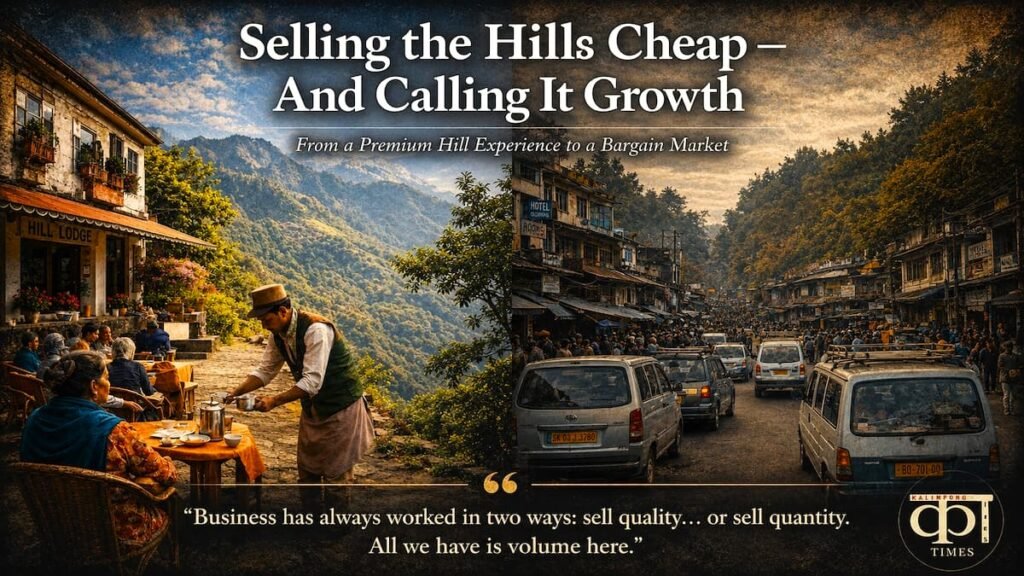
Full rooms. Shrinking margins. Fading value.
Darjeeling tourism appears to be thriving again. The hills are busy, cafés are full, and homestays are welcoming visitors.
But listen to what some local homestay owners are saying.
“Tea is gone… Tourism is pretty much gone too. Earlier we sold rooms for ₹3,000 — food separate. Today, ₹2,400 gets you stay, food and the ‘experience’. Nobody wants to build value anymore. They just want to run it like a ₹500 who*ehouse and leave the leftovers for locals.”
It sounds harsh.
It is also an economic warning.
Somewhere along the way, we stopped competing through quality and started competing through discounts. We undercut one another, bundle everything into one price, and slowly erase the very differences that once justified charging more.
Price became the product.
Experience became the free add-on.
That is a dangerous trade.
Tourists today are increasingly routed, priced and packaged through systems that often sit outside the hills. Meanwhile, many local owners settle for guaranteed leases or lower margins simply to keep occupancy high.
On paper, business continues.
In reality, bargaining power quietly disappears.
The same pattern appears on the plate.
“Our culture—what people once travelled here to experience—is now dissolved into chicken curry and rice. Today, you can’t tell the difference between here and Chowringhee… it tastes the same.”
When every destination serves the same menu, offers the same package and promises the same “local experience,” price becomes the only thing left to compare.
And price is always a race to the bottom.
One owner summed it up simply:
“Business works in two ways: sell quality, or sell quantity. All we have is volume. People bargain even for ₹20.”
That observation reaches beyond tourism.
Coffee, music, education, handmade crafts—every industry eventually faces the same choice. Compete on quality or compete on price. One builds reputation. The other demands ever-growing volume simply to stand still.
The uncomfortable question came next.
“आफ्नै ठाउँलाई आफैं value गरेन भने अरुले कसरी गर्छ?”
If we don’t value our own place, why should anyone else?
The hills were never meant to be a budget shortcut.
They are a premium—not because they’re expensive, but because they offer something that cannot be replicated elsewhere: a landscape, a culture, a pace of life and a history that took generations to shape.
Premium destinations don’t stay premium by being the cheapest.
They stay premium by remaining distinctive.
This isn’t about blaming tourists, outsiders or local businesses. Every business owner responds to the pressures of the market.
The real question is whether we’re shaping that market—or simply reacting to it.
Because if the only measure of success is full rooms, we may wake up one day to discover that we haven’t lost tourism.
We’ve lost the ability to define its value.
The hills are still ours.
The question is: are we building a destination—or merely filling rooms?
Premium destinations around the world rarely compete by being the cheapest. They invest in identity, quality, and experiences that cannot be replicated elsewhere. Price matters, but only after value has been established. The Darjeeling Hills face the same choice: compete on uniqueness or compete on discounts. History suggests only one of those strategies builds lasting tourism.
© Kalimpong Journal. All rights reserved. This article is an original work published by Kalimpong Journal and is protected under applicable copyright laws. No part of this publication may be reproduced, republished, adapted, translated, narrated, distributed, or used to create derivative works in any form—including videos, audiobooks, podcasts, AI-generated adaptations, or commercial content—without prior written permission from Kalimpong Journal.