How a trading town that lost its trade found something to make instead
Nobody in Kalimpong is quite sure when the noodles began.
Ask about the big factory at 8th Mile and you’ll be told 1967.
Or 1966.
Or sometime around 1980, depending on who is remembering, and what they had for lunch.
The town is more certain about the noodles themselves. It has been eating them for longer than it has been arguing about them.
Start in the wool godown.
It is the first dry winter after the Jelep La closed, and the building has stopped smelling of wool.
That took longer than anyone expected. For years the smell of raw fleece had lived in the timber, in the rafters, in the coats of the men and women who worked there. It lingered through the first season of empty floors. Then, one morning, it was simply gone, and the godown smelled of dust and cold iron and nothing else.
The great wooden doors stay open now. There is nothing inside worth closing them on.
A porter named Dorje sits on an upturned crate near the back, with his shoulders still shaped for a load that isn’t there. His hands hang between his knees. Somewhere outside, a mule that has not been told the trade is over stamps once against the frozen ground.
He has carried wool all his life.
He is working out, slowly, what a man does with a skill for lifting heavy things in a town where nothing is arriving.
He is not the only one asking.
I don’t know what Dorje did next. He is invented, and so is the crate. What the record shows is that Kalimpong’s economy slowed after 1962, and that over the following decades a different trade was growing at the edge of the town. No source I could find says the one led to the other, so I haven’t joined them.
The second trade began mostly with Tibetan families, who had been coming down from the plateau since 1959.
By the accounts of people who have studied it, phing was first made in Kalimpong largely by Tibetans, and the skill passed to the people who worked for them.
Picture a low workshop near the saw mill, a little before four in the morning.
A dim bulb hangs from a wire. The air is misty with running water, and long shadows lie across drums of grey paste. Somewhere a grinding stone turns with a sound like a heavy door being closed, again and again.
The mung dal has been ground and drained through a cotton cloth. By seven or eight the first paste will have been collected into barrels, and then the barrels are left alone, because the water and the starch part company without anyone’s help. At three in the afternoon the residue is lifted out, strained again through a thicker cloth, and left overnight.
Most of the work in phing is waiting, arranged around two or three moments when somebody has to do something exactly.
The next day the paste goes through a sieve and comes out as thin as thread, into boiling water, then cold, to rinse away whatever dough is left. Then out to the poles.
The poles are set so that the noodles do not face the mountains. The wind that comes off them is cold, and a dry strand of phing is more fragile than it looks.
A boy named Bir is hired to carry water.
That is all. Not to learn. To carry.
He comes before light, when the lane is still blue and the stones are cold through his sandals. Two buckets, up the steps, a long breath, and back down again. His shoulders ache by the third trip, and by the tenth he has stopped noticing.
But a boy who carries water past a sieve every morning is learning, whether anyone means him to or not. In a year he is allowed to hold it. After that, nobody remembers who first showed him, only that he was good.
Thukpa is another kind of morning.
Above a shop in the bazaar, a woman named Pema has laid a plank across two empty kerosene tins.
The dough sits at one end of it, pale and heavy, under a damp cloth.
She rolls it flat with a pin worn smooth in the middle, turns it, rolls again. The plank creaks on every stroke. A pot of water ticks on the stove, and the window has fogged over so that the street outside is only a blur of passing coats.
Then the knife.
Strips fall away from it in long even ribbons, and she lifts them in handfuls and shakes them loose, and they hang from her fingers like something that has just been shorn.
They are for her own family.
A neighbour tastes them. Then another neighbour. Then somebody’s cousin, who has heard.
Out in the yard, the bamboo poles stand ready.
The strips go over them in the morning, and by noon the yard looks like washing day in a house that takes its washing very seriously. Pale ribbons stir in the wind. A hen walks underneath, unimpressed.
The drying is the part nobody can hurry.
The sun does the work, and the sun does as it likes.
Nothing is wasted.
The cloudy water left in the basin, the thick, pale leftover, is carried to a pot and boiled down. A little turmeric turns it yellow. It is poured onto a flat plate and left to set, trembling a little when anyone walks past.
This is phambi.
It is a by-product of one trade that became a living for another.
Before the town is properly awake, there is already a line at the back door. Jerrycans. Old bottles. A girl in a school sweater, shifting her weight from one foot to the other, trying not to look as though she is counting the people ahead of her.
Somebody always arrives early.
Somebody always has opinions about who.
The weather decides everything.
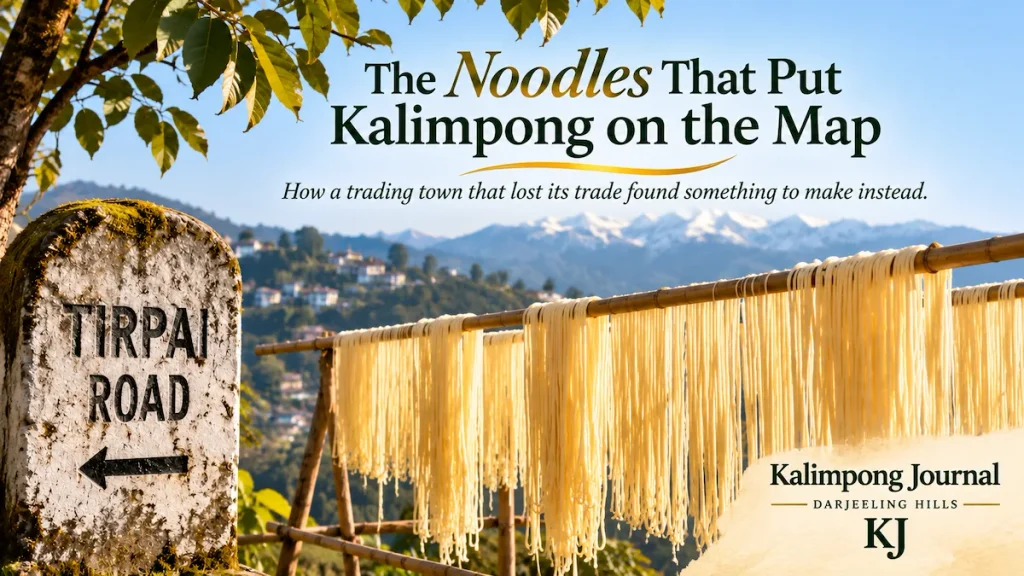
On Tirpai, on a good day, the air is cool and dry and the afternoon sun is gentle. The noodles hang in long pale rows along the hilltop, and from below they look like a section of the sky that has been taken down and strung up to dry.
On a bad day, the cloud comes in off Deolo and sits.
The poles stay bare.
The tarpaulins go over whatever can’t be saved, and the people who have spent a week of mornings on this stand around under a dripping eave and look at the sky.
Then there is the water.
In a dry spell the tap coughs, once, twice, and gives up. A day that was meant to be long is short. Everyone knows what that does to the week.
Meanwhile, at 8th Mile, behind a gate near a school, there is another factory.
Three acres. Wood and brick. A house standing apart from it, quiet as a house that has seen a lot.
It would become the best known in Kalimpong, partly for the noodles and partly for whose it was. Its owner had learned to make them as a child, from his mother, in a village on the other side of the mountains.
The 8th Mile factory is the best-known name in Kalimpong noodles, and its beginnings are disputed. Gyalo Thondup told The Telegraph in 2019 that he started it in 1967. The Statesman gave 1966–67. A review of his memoir has the couple buying the land in 1952 and opening the factory in 1980, and Open’s tribute after his death in February 2025 says around 1980 as well. I couldn’t settle it.
On a Saturday night in May 2019, it caught fire.
Three fire engines went up the road. The flames were put out by eleven. The house, the officer said afterwards, was untouched.
The owner said he would rebuild.
What happened after that is not in the record.
It is the kind of gap a reporter should walk to.
But a town does not become a noodle town because of one factory.
The factory was not the only early unit. Gopal and Lalit Chettri learned phing as young workers in a Tibetan-owned factory near the saw mill. Gopal then opened his own unit, in 1973 according to a 2019 survey and in 1986 according to a later essay. Lalit opened his in 1997 and closed it in 2017. Their brother Yuvraj ran a unit for twenty years, then moved to thukpa, which is less temperamental about water. His son was still making it in 2025.
A worker saves enough to start his own unit.
A son learns the trade from his father, or from a friend who happens to be good at it.
Someone moves from phing to thukpa, because thukpa needs less water, and water has become something to be careful with.
A unit opens in 1997.
Another opens in 2010.
Another, in 2015.
Some close. Some stay, a batch at a time, year after year.
The people who built the industry mostly did it without noticing, the way people build a town.
There is no plaque.
There is only the shelf.
Go into any shop in Kalimpong, and there they are, between the dal and the tea. Plastic packets. A little dust on the top ones. A hand-lettered price.
Nobody looks at them.
They are too ordinary to look at.
Pick one up.
Turn it over.
Read the name printed on the back.
Somewhere in Kalimpong, somebody stood outside this morning, before deciding anything else about the day, and checked the sky.
This is a historical reconstruction based on published accounts of Kalimpong’s trade and noodle-making history. The characters (Dorje, Pema and Bir), the godown scene, the workshop and the rooms above the bazaar, and the individual conversations and moments are imagined, though they are meant to reflect documented practices and conditions. Real people appear only through documented facts, and no words have been invented for them.
Sources and Further Reading
- History of Kalimpong — Official Kalimpong District Website.
- Longing for a Plate of Food in Kalimpong — Anisa Bhutia, Zubaan.
- The Dying Art of Phing and Thukpa Making in Kalimpong — Ishita Rai Dewan, Sikkim Project.
- Noodles and Nehru’s Nod — Vivek Chhetri, The Telegraph, 5 May 2019.
- Not Dalai Lama’s Bro; for Kalimpong, Thondup Was First Maker of Thukpa — The Times of India, 10 February 2025.
- Dalai’s Brother, Champion of the Tibet Cause, and Thukpa — The Times of India, 11 February 2025.
© 2026 Kalimpong Journal. All rights reserved.
All articles, photographs, illustrations and other original content published on this website are the intellectual property of Kalimpong Journal, unless otherwise credited. No part of this publication may be reproduced, republished or redistributed without prior written permission.
Kalimpong Journal | Darjeeling Hills