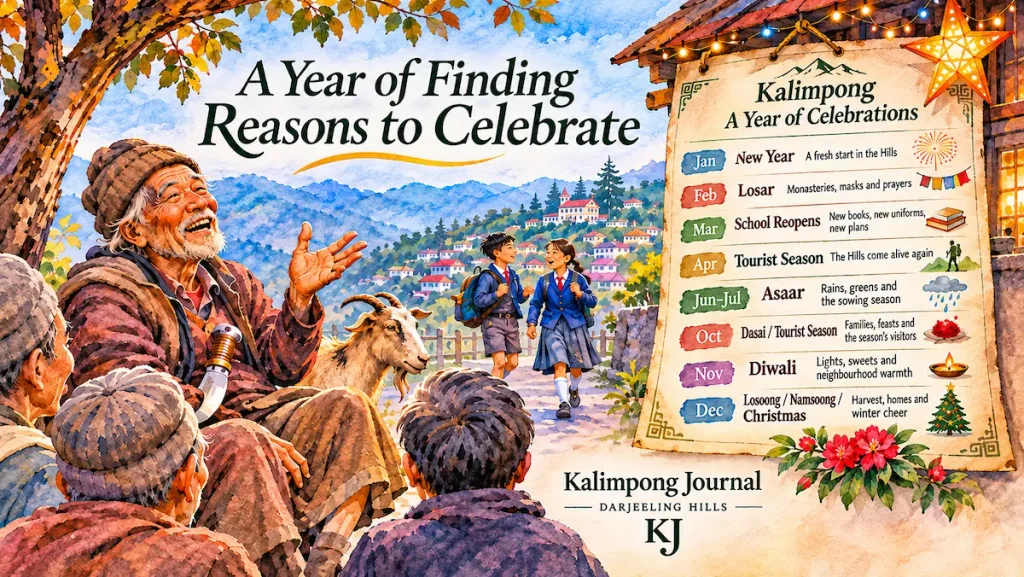
In Kalimpong, the calendar is less a schedule than a succession of occasions. There’s always something coming up, and very little time to get bored.
Now, I may be wrong, but I have a suspicion that the people of Kalimpong do not really follow a calendar. They follow occasions.
Ask someone what time of the year it is, and they will probably tell you what is coming up. Schools are reopening. Summer is approaching. Asaar is here. Independence Day is around the corner. Dasai is coming. Diwali. Namsoong. Christmas. New Year.
There is always something.
Take the reopening of schools in late February or March. The town begins to stir again. Children appear in new uniforms, some looking rather pleased with themselves, others looking as though they have been sent to prison for a crime they cannot remember committing. Parents resume their morning duties. Shoes are polished, bags are packed, and everybody seems to be taking the new academic year rather seriously.
For a few days, the entire town appears determined to get its life together. New timetables, new notebooks, new ambitions. One wonders whether we might actually accomplish something this year.
Then, gradually, the seriousness wears off. By April, we begin to realise that this is, after all, another year rather similar to the last. The notebook, meanwhile, remains considerably more organised than its owner.
Then summer arrives.
The hills grow warmer, the skies clear, and tourists begin appearing with their cameras and itineraries. This is when the local driver discovers that he has become a very important cog in the machinery. His phone rings, his bookings overlap, and the poor fellow may have to explain that he cannot be in three places at once.
Kalimpong looks magnificent, naturally. The drivers are busy. Everyone is making plans.
And then the rain comes.
Asaar is a different being altogether. The hills disappear behind curtains of mist, the roads become slippery, and the countryside begins to demand attention. The farmer has rice to plant; the influencer has to pose for the one plant she is going to plant for her 25K following.
There is work to be done, whether one is working in the fields or clearing an overgrown garden that has been patiently waiting for the monsoon. And somewhere, someone is complaining that the weather has ruined their outdoor lunch arrangements.
By the time August approaches, the mood changes again.
Independence Day brings football, gatherings, young people, and that peculiar excitement which seems to belong to the month. There is a great deal of enthusiasm about the nation, naturally. But I suspect some of the younger generation may also be looking forward to a little romance, perhaps under the respectable cover of an Independence Day celebration.
Patriotism is a beautiful thing. So is having a social life.
Then comes September, when everybody suddenly remembers that there is work to be done. The year is not meant only for recreation and procreation, after all.
Books are opened. College routines resume. People begin talking about discipline, responsibility and the importance of concentrating on one’s future. August is quietly put away, though not necessarily forgotten. Some people take longer than others to recover their seriousness.
Fortunately, Dasai arrives in October.
Now, Dasai is a different matter altogether. Families meet, friends return, journeys are made, and the town becomes busy once again. There is meat, there is drink, and there are people who have not seen one another since the previous Dasai. Everyone has a story to tell, though some stories improve considerably with each passing year.
I ran into Jetha the other afternoon, wandering around the neighbourhood with the unsteady dignity of a man who had once been considerably better off. In his younger days, Jetha had been a successful goat herder. Women and alcohol, he will tell you if you give him enough time, were responsible for the rest.
Dasai, naturally, is his favourite subject.
He will tell you how, in those prosperous days, he could bring down a goat with a single swing of his khukuri. One stroke, he insists. No second attempt, no unnecessary fuss. Then he gets around to the gold rings and necklaces, which feature prominently in his recollections of those days.
He tells the stories with such conviction that, for a moment, you almost forget the fellow standing before you. The old goat herder is still there somewhere, beneath the years, the drink and the neighbourhood dust.
I left him to his stories. He was doing rather well, and I had no reason to interrupt a man who had already lost most of his audience.
November brings another kind of excitement. Students begin worrying about examinations, while businesses prepare for Diwali. Somewhere, a student is desperately looking for revision notes that should have been collected weeks ago. Somewhere else, a shopkeeper is arranging goods, calculating sales and preparing for the festive rush.
By December, the year begins to feel old. There is anticipation in the air, along with a chill.
Christmas lights appear, people start discussing New Year plans, and Chinese sausage prices have gone up again this year. Businesses prepare for the last big sale before the calendar changes. Everybody seems to have something to look forward to. Even those who have accomplished very little during the year can still make ambitious resolutions for the next one.
There is no shortage of optimism in Kalimpong.
January arrives with cold mornings, melas, picnics and riverside outings. The first week is often spent enjoying oneself, which is a perfectly sensible way to begin a calendar year. After all, one must establish certain priorities.
Then work resumes.
And just when everyone is settling down to a practised routine, February brings board examinations, last-minute revision notes and mock papers. The approaching school reopening also provides a fresh opportunity for local tailors to make a little money. The cold may linger into March or even April, but the calendar has already started moving again.
You see, I have come to believe that people are rather ingenious in finding reasons to celebrate.
There is always an occasion somewhere in the distance. One begins looking forward to it, making arrangements, saving a little money, calling friends, planning journeys. The event itself may last only a few days, but the anticipation can occupy weeks. And after it is over, there is the aftermath: catching up, recovering, remembering and occasionally regretting.
Now, if you ask me, we could probably get a great deal more work done if society had only two festivals a year, six months apart. Think of the productivity! No sooner would we finish one occasion than we could begin preparing for the next.
But what would we do with all that extra time? Knowing human beings, I suspect we would find something else to celebrate.
A machine might organise our calendar more efficiently, eliminate unnecessary holidays and ensure that everyone remains productive throughout the year. But it would probably never understand why people need something to look forward to.
We make do with what we have, find a reason to gather, and celebrate whenever the opportunity presents itself.
In Kalimpong, the year never quite gets started.
It is always about to begin again.
© 2026 Kalimpong Journal. All rights reserved.
All articles, photographs, illustrations and other original content published on this website are the intellectual property of Kalimpong Journal, unless otherwise credited. No part of this publication may be reproduced, republished or redistributed without prior written permission.
Kalimpong Journal | Darjeeling Hills